
By Imed Laaridh, Director of Zaion Lab
Automated customer engagement is at a turning point. After years of promises—and a few disappointments—business leaders have learned to ask the right questions. No longer “Should we adopt conversational AI?” but “How can we turn it into a real, controlled, and sustainable driver of performance?”
At Zaion, we feel strongly about this issue. And this conviction is rooted in experience: hundreds of production deployments across demanding sectors such as insurance, banking, public services, and social security. These are environments where a seamless solution isn’t enough—it must also be compliant, traceable, and aligned with business processes.
What Companies Have Actually Learned from Generative AI
The emergence of large language models (LLMs) has sparked genuine enthusiasm. For the first time, it became possible to design conversational agents capable of handling varied phrasing, non-linear conversations, and complex intentions—without having to formalize every rule in advance.
But companies that have tried to build their customer relationship systems on an exclusively generative basis have quickly run into concrete obstacles:
Infrastructure costs skyrocket as soon as volumes increase
Responses that are smooth but not always accurate or in line with internal policies
A challenge for policymakers: How can we verify what an official has said, and why?
Increased exposure to risks, particularly when a single individual holds too much access and too many responsibilities
This is not a criticism of the technology. It is simply an observation that generative AI, when deployed without a suitable architecture, quickly becomes as much of an operational problem as it is a solution.
The other extreme also has its limits
Deterministic systems—scripted workflows, decision trees, and fully hard-coded paths—have served us well. They offer control, predictability, and a good fit for regulated processes.
But their limitations become apparent as soon as customer interactions grow in volume and complexity. Conversations become rigid. A customer who rephrases a question, changes their mind, or strays from the script finds themselves stuck. And the teams managing these workflows spend an increasing amount of time handling a growing number of use cases.
Our answer: a hybrid architecture, not a compromise
At Zaion, we don’t choose between these two models. We bring them together.
Our platform is built on a modular approach: the conversational flow is broken down into specialized agents, each dedicated to a specific step. Each agent employs the appropriate approach depending on what the situation requires—deterministic where control and compliance are priorities, and generative where fluidity and adaptability create real value.
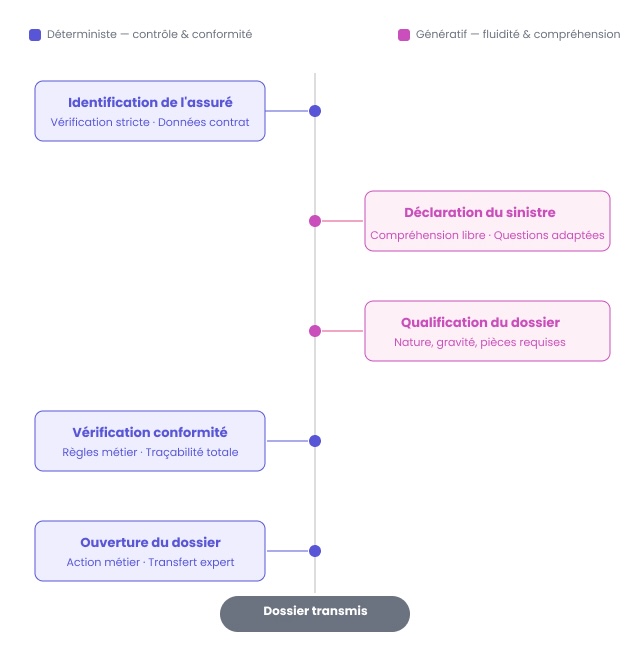
In practical terms, this means that a claims filing process can begin with a strictly deterministic authentication step, continue with a generative-assisted information-gathering phase to better understand the policyholder’s situation, and conclude with a business action—such as opening a case or transferring the claim to an adjuster—that is managed in a fully controlled manner.
The result, measured in terms of production:
Better control over LLM costs, because generative models are used only where they add value
Enhanced compliance at critical stages
A smoother, more natural customer experience throughout the conversational flow
Full observability: every decision and every interaction can be tracked, audited, and explained
Example of the integration of a deterministic model and a generative model in an insurance journey:
The future belongs to architectures that know how to make the right choices
True maturity in conversational AI for businesses doesn’t mean betting everything on the most powerful model. It means knowing, at every stage of the customer journey, what level of intelligence, flexibility, and control is actually needed.
This ability to discern—both architectural and strategic—is what we’re building at Zaion Lab. And the acquisition of Dydu gives us the means to deploy it on a whole new scale, across all customer engagement channels.
Imed Laaridh is the Director of Zaion Lab, Zaion’s R&D division dedicated to innovation in conversational, generative, and voice AI. Zaion has just announced the acquisition of Dydu to become France’s leading provider of multi-channel agent-based AI for customer relations.